A private European company reaches orbit with its own rocket for the first time
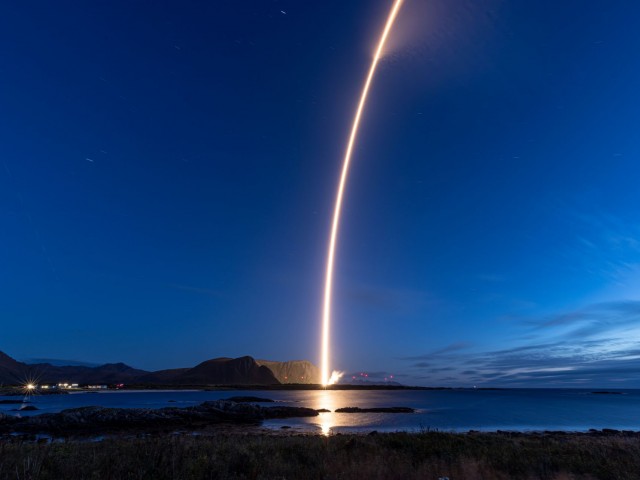
On 5 September, the Spectrum launch vehicle built by the German company Isar Aerospace lifted off from Andøya Spaceport in Norway, reached Earth orbit and deployed its satellites. It is the first time a private European company has delivered a payload to orbit using a launch vehicle of its own design, and also the first orbital launch from continental Europe. The mission was co-funded by the European Space Agency (ESA), of which Latvia has been an Associate Member since 2020.
The rocket lifted off at 22.12 CEST. A little over seven minutes later its second stage entered an elliptical orbit at roughly 180 to 500 kilometres, then performed a circularisation burn and released its payload. The mission, named Onward and Upward, carried five CubeSat-class small satellites and one scientific experiment into orbit. The payloads were selected through the German Space Agency (DLR) microlauncher competition, which gives educational institutions and start-ups access to space at a fraction of commercial market prices.
This was Spectrum's second flight. The first, in March 2025, ended less than a minute after lift-off; the investigation identified an unplanned valve opening and a loss of attitude control. The second attempt was also delayed: initially scheduled for January, it was postponed because of technical issues, weather and even a vessel entering the safety zone.
For years Europe has lacked launch vehicles of its own for placing satellites in orbit. European universities and companies have usually flown their instruments on rockets built on other continents, adapting to other operators' schedules and prices. The continent now has one more independent option.
Isar Aerospace received funding in several rounds under ESA's Boost! programme, which supports commercial space transportation service providers. ESA Director General Josef Aschbacher notes that this success was achieved by a company founded only eight years ago, and that the launch is a further step towards a more diverse and more autonomous European launch services sector.
With this flight the company has also met the initial condition of ESA's European Launcher Challenge, which requires providers to complete an orbital flight no later than 2027 — something no other participant has yet achieved. ESA Director of Space Transportation Géraldine Naja calls the event historic: until now, no European company had reached orbit with its own launch vehicle.
Latvia has been an ESA Associate Member since 2020. That membership pays off: estimates indicate that every euro invested in it returns around 1.4 euros to Latvia, in the form of contracts and projects won by Latvian high-technology companies and research institutions.
Isar Aerospace is a direct example of what such membership can deliver. Founded in 2018 as a spin-off of the Technical University of Munich, in eight years the company grew from a student initiative into a business that puts satellites into orbit on its own.
What opportunities ESA opens up for a given country depends directly on which of the agency's programmes that country joins and invests in. Latvia takes part in several ESA programmes, and their results are already visible today In November 2024, for example, the ESA Business Incubation Centre "ESA BIC Latvia" opened at the Science and Innovation Centre of Riga Technical University, supporting the growth of space-sector start-ups. That is precisely the kind of support that was the starting point for Isar Aerospace.
The practical benefit is straightforward: the more small-satellite launch options Europe has, the cheaper and faster a small university team or start-up can reach orbit. For instruments and small-satellite solutions developed in Latvian universities and research institutes, the path from the laboratory to orbit becomes shorter and less expensive, and it no longer depends on one or two global operators.
The company is already building the next five Spectrum rockets and a new production facility near Munich, where it plans to manufacture up to 40 launch vehicles a year in the long run.
Sources: European Space Agency, Isar Aerospace, Space.com